Showing 36 of 36 definitions. Click any card to copy its summary.
Single Crochet
US: sc·UK: dc (double crochet)
The fundamental crochet stitch. Creates a compact, dense, and sturdy fabric.
How to work: Insert hook in stitch, yarn over, pull up a loop (2 loops on hook). Yarn over, pull through both loops.
Tip:The backbone of amigurumi. Keep tension consistent so polyfill stuffing never peeks out through tiny gaps.
Double Crochet
US: dc·UK: tr (treble crochet)
A taller stitch than single crochet, often used for open, draping fabric.
How to work: Yarn over, insert hook, yarn over and pull up a loop (3 loops on hook). Yarn over, pull through 2 loops. Yarn over, pull through final 2 loops.
Tip:The heart of classic granny squares. If your stitches feel loose or floppy, try downsizing your hook by 0.5 mm.
Half Double Crochet
US: hdc·UK: htr (half treble)
Midway between single and double crochet in height. Features a unique third loop on the reverse.
How to work: Yarn over, insert hook, yarn over and pull up a loop (3 loops on hook). Yarn over, pull cleanly through all 3 loops at once.
Tip:Ideal for warm beanies and sweaters. Working into the hidden third loop pushes the top V forward to mimic knit stockinette ribbing.
Slip Stitch
US: sl st·UK: ss
The flattest stitch in crochet. Used to join rounds seamlessly or travel across stitches.
How to work: Insert hook in stitch, yarn over, pull loop through the stitch and directly through the loop on your hook in one smooth stroke.
Tip:Avoid tugging this stitch tight. Beginners tend to overtighten slip stitches, making them stubborn to crochet into later.
Treble (Triple) Crochet
US: tr·UK: dtr (double treble)
A tall, airy, open stitch that creates sweeping drape for shawls and lace edgings.
How to work: Yarn over twice, insert hook, yarn over, pull up a loop (4 loops on hook). [Yarn over, pull through 2 loops] three times.
Tip:Because of its height, treble crochet can lean. Support the base of the pillar with your thumb while working the yarn overs.
Double Treble Crochet
US: dtr·UK: ttr (triple treble)
An extra-tall lace stitch created by wrapping three yarn-overs before inserting.
How to work: Yarn over 3 times (4 loops on hook). Insert hook, yo, pull up a loop (5 loops). [Yarn over, pull through 2 loops] 4 times.
Tip:Used frequently in intricate doily spokes, mandala petals, and dramatic drop-stitch borders.
Increase
US: inc / 2 sc in next st·UK: inc / 2 dc in next st
Adding one or more stitches to widen the fabric or expand circular rounds.
How to work: Work 2 (or the specified number of) stitches directly into the exact same stitch or space.
Tip:When crocheting amigurumi spheres, stagger your increase positions across even rounds to prevent hexagonal corners.
Decrease (Single Crochet)
US: dec / sc2tog·UK: dec / dc2tog
Merging two adjacent stitches into a single top stitch to narrow the row or taper shapes.
How to work: Insert hook into next st, yo, pull up a loop (2 loops). Insert into following st, yo, pull up a loop (3 loops). Yo, pull through all 3 loops.
Tip:For smooth flat garments this standard decrease works well, but for stuffed toys use the Invisible Decrease instead.
Invisible Decrease
US: invdec·UK: invisible dec
A front-loop decrease often used to make shaping less visible in right-side-out single crochet.
How to work: Insert hook through FRONT LOOP ONLY of first st, then immediately through FRONT LOOP ONLY of second st. Yo, pull through both front loops. Yo, pull through remaining 2 loops.
Tip:Use the decrease specified by your pattern and check the result with your yarn and tension.
Double Crochet 2 Together
US: dc2tog·UK: tr2tog
Decreasing across two double crochet stitches to shape armholes, necklines, or chevron waves.
How to work: Yo, insert in next st, yo, pull up loop (3 loops). Yo, pull through 2 (2 loops remain). Yo, insert in next st, yo, pull up loop (4 loops). Yo, pull through 2 (3 loops). Yo, pull through all 3.
Tip:Essential for chevron and ripple blankets, where a dc2tog or dc3tog creates the valley between the wave peaks.
Front Post Double Crochet
US: FPDC·UK: FPTR
Worked around the vertical post of the stitch below rather than the top loops, raising it forward.
How to work: Yo, insert hook from front to back to front around the post of the stitch in the row below. Yo, pull up a loop. Complete standard double crochet.
Tip:Alternating FPDC with BPDC creates elastic, stretchy crochet ribbing that looks remarkably like 1x1 knit ribbing.
Back Post Double Crochet
US: BPDC·UK: BPTR
Worked around the post from the rear, pushing the fabric backward into recessed grooves.
How to work: Yo, insert hook from back to front to back around the post of the stitch below. Complete standard double crochet.
Tip:Keep your tension relaxed when wrapping the hook around the back post so the fabric does not pucker.
Bobble Stitch
US: bobble / bo·UK: bobble
A cluster of 4 or 5 incomplete double crochets worked into one stitch and closed together to pop outward.
How to work: [Yo, insert hook, yo, pull up loop, yo, pull through 2] 5 times in same st (6 loops on hook). Yo, pull through all 6 loops. Ch 1 to lock.
Tip:Bobbles always pop out on the OPPOSITE side of your work. Push them toward the right side with your finger as you work the next single crochet.
Popcorn Stitch
US: popcorn / pc·UK: popcorn
A rounded 3D berry texture made by working 5 full double crochets and pulling the last loop through the first.
How to work: Work 5 complete dc in same stitch. Drop working loop from hook. Insert hook front-to-back through 1st dc, pick up dropped loop, pull through.
Tip:Check the pattern’s definition: stitch counts and closing chains can vary. Follow the yarn care label when washing.
Puff Stitch
US: puff / ps·UK: puff
A soft, cloud-like squishy stitch made from repeated yarn-overs pulled up to height.
How to work: [Yo, insert hook in st, yo, pull up loop to height of hdc] 3 to 5 times (7 to 11 loops). Yo, pull through all loops. Ch 1 to close.
Tip:Puffs can use substantial yarn. Measure a swatch instead of assuming a fixed percentage more than another stitch.
Picot Stitch
US: picot·UK: picot
A small, pointed decorative loop used on lace borders, snowflake tips, and blanket hems.
How to work: Ch 3. Insert hook into 3rd chain from hook (or through the front loop and left leg of base st), sl st to close.
Tip:For sharper picots that don't twist, slip stitch into the front loop AND left vertical bar of the single crochet below.
Shell Stitch
US: shell·UK: shell
A decorative fan-shaped cluster of 3, 5, or 7 stitches worked into one single base stitch.
How to work: Work 5 dc into the indicated stitch or chain space. Typically anchored by skipping 2 stitches and working a single crochet.
Tip:Great for quick baby blankets. Shell stitches create scalloped edges naturally without needing an extra border row.
Chain Stitch
US: ch·UK: ch
The starting line for almost every flat crochet project. Also creates turning chains, spaces, and mesh.
How to work: With a slip knot on the hook, yarn over and pull through the loop. Repeat for each chain. Do not count the slip knot or active loop.
Tip:If the starting edge pulls inward, check the stitch count and try a looser chain on a sample.
Magic Ring (Magic Circle)
US: MR / magic ring·UK: magic ring
An adjustable starting loop that pulls completely closed. Eliminates the center hole in round projects.
How to work: Cross yarn over fingers like an X. Pull yarn under the front strand, catch back strand, make 1 chain to secure. Work stitches over both strands, then pull tail tight.
Tip:Weave your starting tail in three alternating directions with a blunt needle. If you just snip it, your center circle will pop open in the wash.
Foundation Single Crochet
US: FSC·UK: FDC (foundation dc)
Builds a chain base and a row of single crochet together.
How to work: Ch 2. Insert hook in 1st ch, yo, pull up loop (2 loops). Yo, pull through 1 loop (chain formed). Yo, pull through 2 loops (sc formed). For each following stitch, insert under both loops of the chain base just made, pull up a loop, yarn over and pull through one to form the next chain base, then yarn over and pull through two.
Tip:A game changer for sweater hems and hats. Unlike a stiff standard chain, foundation stitches stretch with your body.
Foundation Double Crochet
US: FDC·UK: FTR (foundation tr)
Builds a chain base and a row of double crochet together.
How to work: Ch 3, yo, insert in 1st ch, yo, pull up loop. Yo, pull through 1 (chain base). [Yo, pull through 2] twice (dc complete). For each following stitch, yarn over, insert under both loops of the chain base just made, and pull up a loop. Yarn over and pull through one for the new chain base; yarn over and pull through two twice.
Tip:Perfect for starting blankets without counting 200 tiny chains in advance.
Turning Chain
US: tch·UK: tch
Chains made at the beginning of a row to bring your hook up to the working height of the next stitch.
How to work: Chain 1 for single crochet (rarely counts as a stitch). Chain 2 for half double. Chain 3 for double crochet (usually counts as stitch 1).
Tip:Check whether the turning chain counts as a stitch before choosing your first and last stitch positions. Keep the same convention throughout a sample.
Back Loop Only
US: BLO·UK: BLO
Working into only the loop farthest away from you, leaving the front loop exposed.
How to work: Look at the V on top of the stitch. Insert your hook down through the center of the V, catching only the rear strand.
Tip:Working in the back loop creates natural ridges that stretch like accordion paper. Perfect for hat brims and boot cuffs.
Front Loop Only
US: FLO·UK: FLO
Working into only the loop closest to you.
How to work: Insert your hook from the bottom up under only the strand closest to your body.
Tip:Used frequently in amigurumi to attach skirts or hair, or for clean invisible decreases.
Repeat Sequence
US: * ... * or [ ... ]·UK: * ... * or [ ... ]
Instructions enclosed within asterisks or brackets to be repeated a specific number of times.
How to work: Crochet the sequence inside the symbols, then repeat that exact sequence across the row as directed.
Tip:Count your repeats with locking stitch markers so you know immediately if your row count drifts.
Chain Space
US: ch-sp / ch-1 sp·UK: ch-sp
The gap beneath a chain on the previous row. You work into the opening itself, not through the chain loops.
How to work: Insert hook entirely under the chain strand into the air space beneath it, yarn over, and work your stitch.
Tip:Working into the space is much faster and cleaner than picking apart individual chain strands.
Skip
US: sk·UK: miss
Pass over the indicated number of stitches without crocheting into them.
How to work: Do not work into the next stitch. Move your hook directly to the subsequent stitch instructed.
Tip:UK patterns frequently use the word 'miss' instead of 'skip'. They mean the exact same action.
Stitch Marker
US: PM (place marker) / SM (slip marker)·UK: PM / SM
Locking plastic pins used to hold active loops, mark the first stitch of a round, or track increases.
How to work: Clip a locking stitch marker through both loops of the stitch just made.
Tip:Always mark stitch 1 of every row. Straight blanket edges are 90% stitch markers and 10% luck.
Fasten Off (Bind Off)
US: FO / fasten off·UK: cast off / fasten off
Securing the final working loop and snipping the yarn when a project or color section is finished.
How to work: Cut yarn leaving an 8-inch tail. Pull the tail completely through the active loop on your hook and snug gently.
Tip:Never cut tails shorter than 6 inches. Short tails inevitably unravel after a few trips through the washing machine.
Right Side / Wrong Side
US: RS / WS·UK: RS / WS
RS refers to the public-facing outside of the finished piece; WS refers to the inner reverse side.
How to work: Follow the pattern’s designation of right and wrong sides. Odd and even row numbers alone do not establish the right side.
Tip:Once identified, mark the right side so you can recognise it after setting the project down.
Yarn Over
US: yo·UK: yoh (yarn over hook)
Wrapping the working yarn over the crochet hook from back to front.
How to work: Bring the yarn behind the hook, over the top toward yourself, then down the front.
Tip:Make sure you go back to front. Yarn under (front to back) produces a smaller, stiffer cross stitch often used in Japanese amigurumi.
Gauge Swatch
US: gauge·UK: tension
Stitch and row counts measured over a specified area to check finished sizing.
How to work: Make a sample larger than the measurement area in the pattern. Wash and dry it as instructed, then measure the central area, away from the edges. Compare both stitch and row gauge.
Tip:Make and measure a gauge sample before starting a fitted project. Use the pattern instructions and yarn care directions.
Frogging
US: frog·UK: rip out
Pulling on the working yarn to unravel stitches back to a previous point. Named because you 'rip-it, rip-it'.
How to work: Remove the hook, gently pull the working yarn until the mistake is undone, then carefully re-insert the hook through the working loop.
Tip:Do not be afraid of frogging. It is not wasted time. The yarn is still good and your finished piece will look so much better.
Blocking
US: block·UK: block
Wetting or steaming finished crochet pieces and pinning them to measurements to even out tension and open lace.
How to work: Choose a method allowed by the yarn care label, test a sample, and gently shape to measurements. Allow it to dry completely.
Tip:Blocking may even small differences, but it cannot replace missing stitches or correct a major gauge mismatch.
Dye Lot Number
US: dye lot·UK: shade / batch
A batch code on yarn ball bands verifying skeins were dyed in the exact same dye bath.
How to work: Inspect the paper band for 'Lot #'. Verify all skeins bought for a single project have the identical number.
Tip:Yarn from different dye lots can look identical under store fluorescent lights but show an obvious line under sunlight.
Cake vs. Hank vs. Skein
US: cake / hank / skein·UK: ball / hank
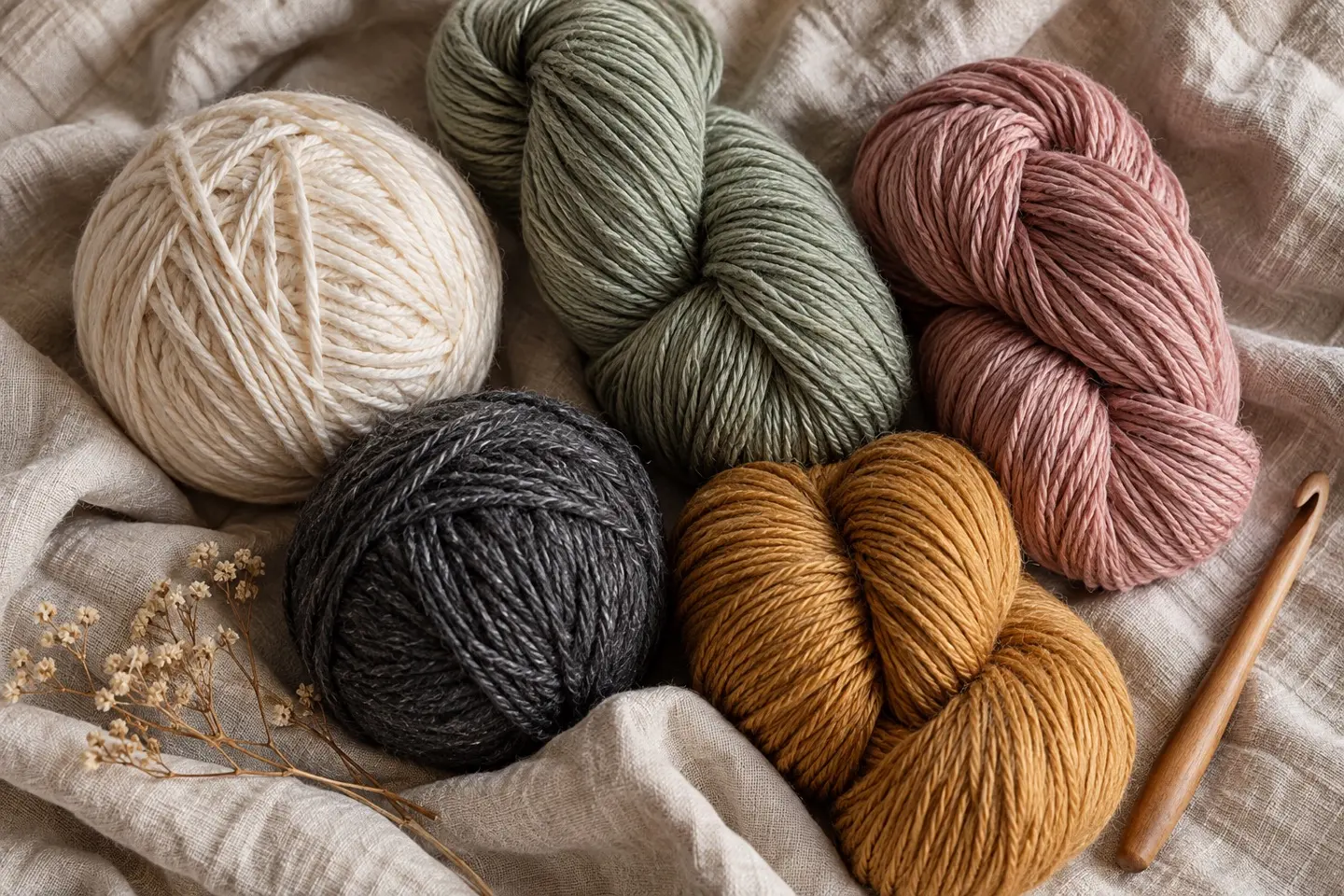
A skein is pre-wound and ready to pull. A hank is a large twisted loop that MUST be wound before crocheting.
How to work: Never pull from an unwound hank directly or it will knot into bird's nest chaos. Wind it into a center-pull cake using a swift.
Tip:If you don't own a yarn winder, loop the hank over the back of two dining chairs and wind a center-pull ball by hand.
Explore the fibres and colours; use the table below for weight guidelines.
Craft Yarn Council (CYC) Weight Standards
From delicate 0 Lace thread to massive 7 Jumbo roving. Know your gauge before casting on.
CYC #
Category
Common Names
Gauge (4")
Metric Hook
Typical Uses
0
Lace
Fingering 10-count, Crochet Thread
32–42 double crochets per 4 inches
Use the thread label; steel and regular sizes differ
Doilies, delicate vintage lace edgings, fine shawls
1
Super Fine
Fingering, Sock, Baby
21–32 stitches per 4 inches
2.25 mm – 3.5 mm
Socks, lightweight baby garments, delicate shawls
2
Fine
Sport, Baby
16–20 stitches per 4 inches
3.5 mm – 4.5 mm
Lightweight sweaters, baby blankets, spring accessories