Moss Stitch (Linen Stitch): The Most Satisfying Woven Texture
By The Slow Stitch · Terminology: US Crochet Terms · Reading time: 6 min read · theslowstitch.com
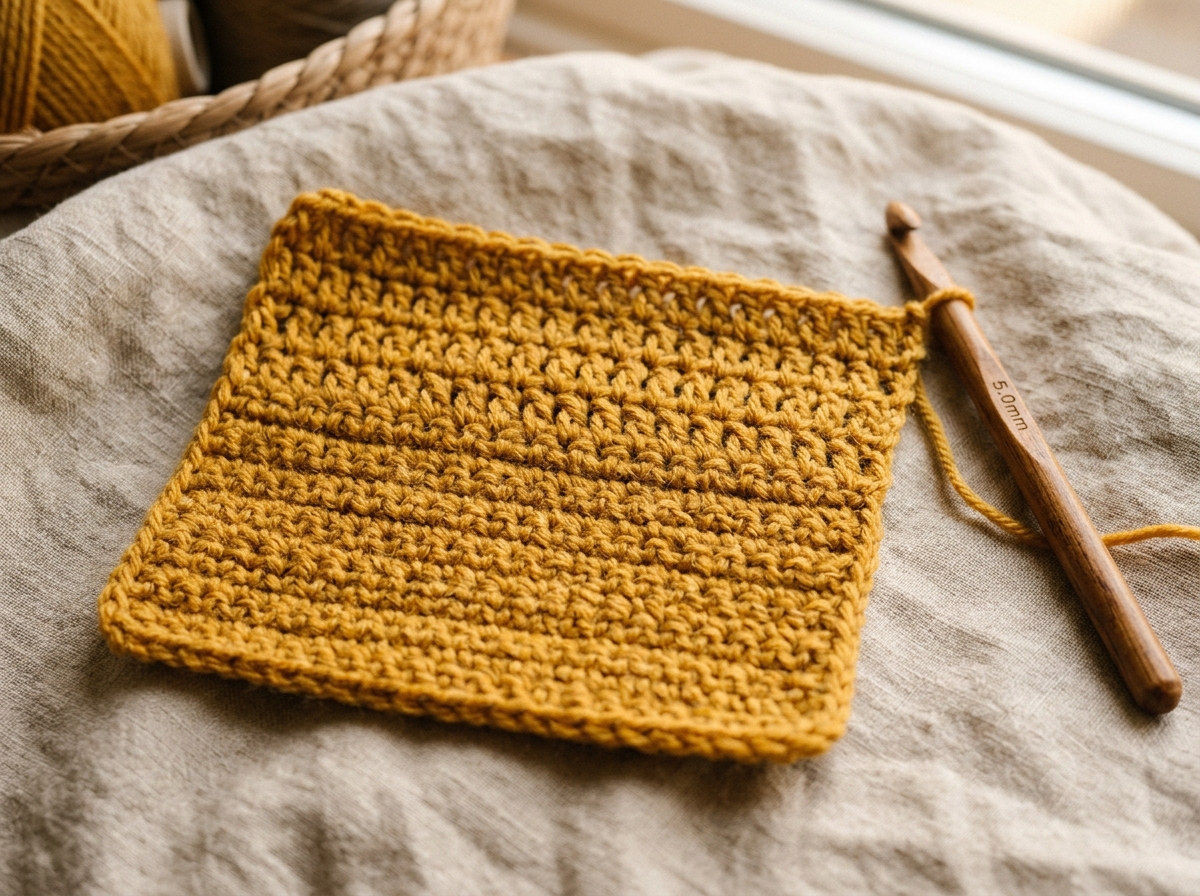
Moss stitch, also called linen stitch, alternates single crochet with chain spaces. After the setup row, you work into those spaces rather than the tops of the single crochets. This sample uses US terms and a 24-chain start.
What You'll Learn
By the end of this tutorial you will be able to:
- Set up an even-chain moss-stitch sample
- Work single crochet into chain spaces
- Find the final turning-chain space
- Count worked stitches and turning chains separately
What You Need
Worsted weight or DK yarn in 1 to 3 colors
5.5 mm (one size up from yarn recommendation)
Scissors, Tapestry needle
Use the materials above for practice, adjusting the hook if needed for comfortable stitches. For a finished project, follow its pattern’s yarn, gauge and care requirements.
Abbreviations
| Abbr | Full Term |
|---|---|
| ch | chain |
| sc | single crochet |
| sk | skip |
| ch-sp | chain space |
Chain an Even Number
Make a foundation chain with any even number of chains (for example, 24 chains for a practice swatch).
Row 1 Setup
Single crochet into the 4th chain from the hook (the 3 skipped chains count as 1 sc and 1 ch space). *Chain 1, skip 1 chain, single crochet into the next chain.* Repeat from * to * across the row, ending with a single crochet in the final chain.
Row 2 (Working into Spaces)
Chain 2 and turn; this counts as one sc plus a chain-1 space. Skip the first sc. Sc in the next chain-1 space. Repeat [ch 1, skip the next sc, sc in the next chain space] across, with the final sc in the starting chain-3 space of row 1. On later rows, the final sc goes in the previous turning chain-2 space.
Repeat Row 2 for the Pattern
Every subsequent row is identical to Row 2. Chain 2, turn, and single crochet into each chain-1 space across, separating them with chain 1. With the 24-chain start, every row has 11 worked sc plus the starting/turning chain counted as one sc (12 sc positions total), and 11 chain spaces.
The Turning Chain Rule
In moss stitch, chain 2 at the start of the row acts as [1 single crochet + 1 chain space].
This allows you to jump directly into the first chain-1 space without creating a tight, pinched edge.
Prefer to learn from a printed page?
Print this free lesson for a simple copy of the instructions. The planned paid PDFs are separate complete projects, with materials, measurements, step photos and finishing guidance.
Common Problems
| Problem | Cause | Fix |
|---|---|---|
| Edges are sloping outward or inward | Missing the final stitch in the turning chain space, or adding an extra stitch at the start | For this 24-chain sample, count 11 actual sc and the starting/turning chain counted as one sc: 12 sc positions, with 11 chain spaces. Mark the final turning-chain space so you do not miss it. |
| Fabric feels stiff and cardboard-like | Chain-1 spaces are worked with tight tension | Go up 0.5 mm or 1.0 mm on your hook size to let the fabric breathe and drape. |
| The fabric looks crooked or diagonally skewed | Pulling too hard to the left when working stitches into spaces | Relax your hands and gently pat the swatch flat every 4 rows. |
Frequently Asked Questions
Is moss stitch good for variegated (multi-colored) yarn?
It can work well with variegated yarn, but the colour pattern depends on the yarn’s colour-repeat length, width and gauge. Make a sample to see the effect.
Does moss stitch eat a lot of yarn?
Yarn use depends on gauge, dimensions, and fibre. Measure a sample in your chosen stitch rather than assuming a fixed saving over single crochet.
Can I use moss stitch for a temperature blanket?
Yes. Its short rows can suit a temperature blanket, but plan the finished dimensions and yarn quantity before assigning one row to each day.
Do I need to block moss stitch?
Shape it if needed using a method allowed by the yarn label. Test on a sample first; do not assume the yarn tolerates steam.
Save this tutorial or share with your crochet circle
What to Make Next
Three logical next steps to continue practicing:
Half Double Crochet: The Most Versatile Middle Stitch
Continue with this related lesson.
Double Crochet: Faster, Softer Fabric in US Terms
Continue with this related lesson.
Classic Granny Square: The Step-by-Step Method
Continue with this related lesson.