The Complete Beginner's Guide to Crochet
From your very first slip knot to your first finished project, written with patience and zero craft jargon.
1. The Only Tools You Actually Need to Start
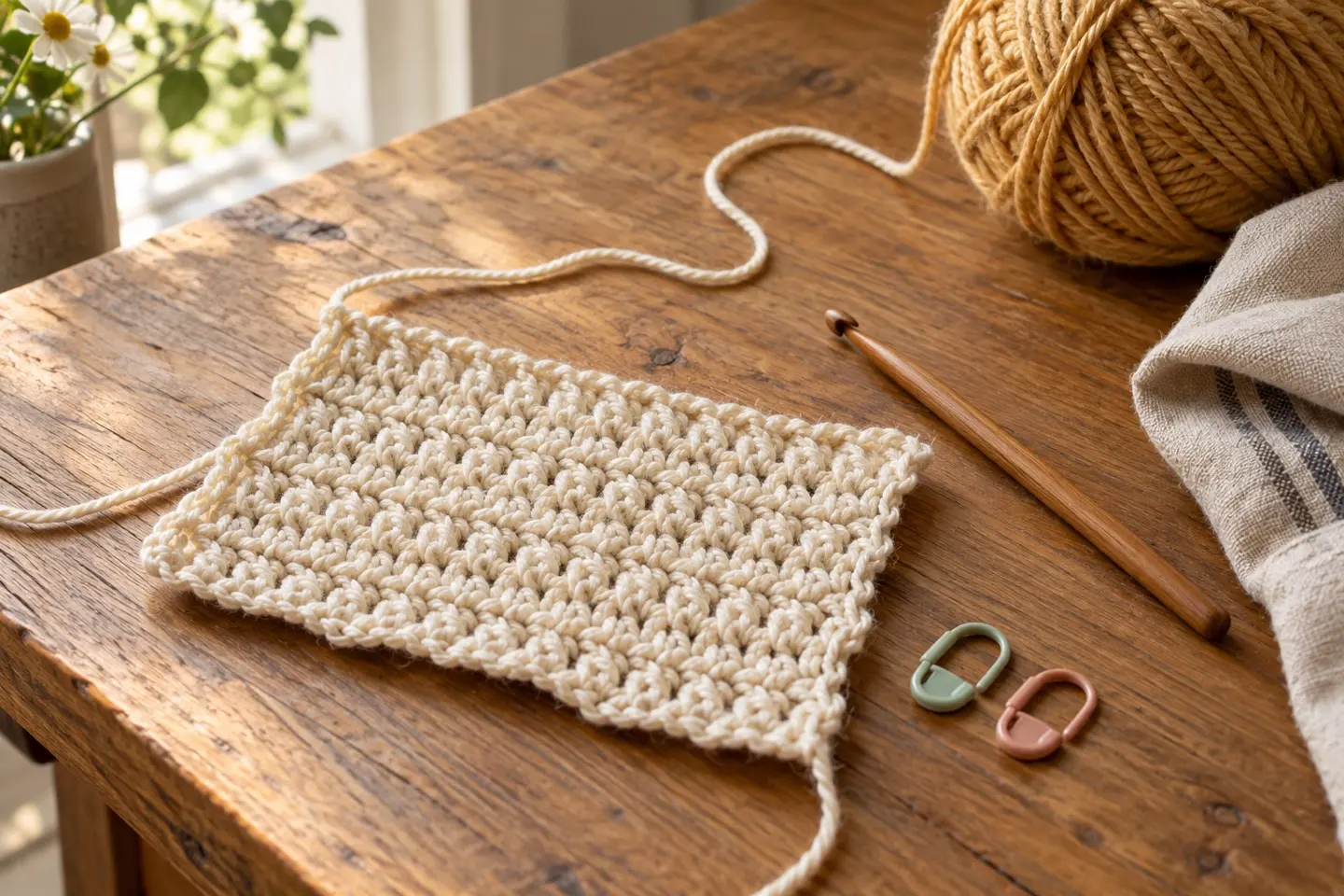
A small, comfortable starter kit is enough for a practice swatch.
Choose smooth, light-coloured yarn, a hook compatible with its label and comfortable for you, scissors, a blunt yarn needle and a couple of stitch markers. Worsted-weight yarn with a 5–5.5 mm hook can be a useful starting sample; adjust if the fabric is too tight or loose. Light yarn makes it easier to see individual stitches.
2. Finding Your Grip: Knife vs. Pencil and Yarn Tension
There is no single correct way to hold a hook. Pick the grip that keeps your wrist relaxed.
Two common grips are the knife grip, where you hold the handle overhand like cutting bread, and the pencil grip, where you cradle the hook between your thumb and index finger. Choose a comfortable grip; neither is a requirement. What matters is your non-dominant hand. That hand regulates how fast the yarn slides off the skein. If you wrap the yarn three times around your pinky, you will choke the strand and pull your loops tight. Let the strand glide lightly over your index finger and pinch your project with your thumb and middle finger right beneath the active loop.
3. The Core Stitch Ladder: Single, Half Double, and Double
Single, half double and double crochet use related movements to create different stitch heights.
In US terms, single crochet uses no initial yarn over; half double and double crochet begin with one. Each has a different pull-through sequence. Practise the individual lessons, count the stitches and follow their turning-chain convention. Stitch placement and tension also affect the finished fabric, and more advanced stitches introduce other movements.
4. Keeping Edges Straight: The Turning Chain Rule
Missing edge stitches can make a rectangular sample narrow.
A missed edge stitch can make a swatch shrink as it grows. You start with 20 stitches, and ten rows later you have 15. This happens because the turning chain at the start of each row behaves differently depending on the stitch height. In single crochet, the chain 1 does not count as a stitch, so you must work into the very first stitch right under the chain. When a double crochet pattern counts chain 3 as the first stitch, skip the stitch at its base and work into the top of the turning chain at the end of the next row. Other patterns use a different turning method, so follow their specific instructions. Place a locking stitch marker in your first and last stitch of every row until your eyes spot the edges naturally.
5. Decoding the Shorthand and US vs. UK Terms
Patterns look like algebra until you realize each abbreviation is just a three-letter recipe.
Crochet shorthand is concise because spelling out every yarn over would make a blanket pattern twenty pages long. A line like 'Ch 21, sc in 2nd ch from hk and across (20)' simply means: make 21 chains, put one single crochet in the second chain from your hook, and work one single crochet into each remaining chain until you have twenty stitches. Before you pick up your hook, verify whether the designer is writing in US or UK terminology. A US single crochet is called a double crochet in the UK. If you work a British pattern with American double crochets, the stitch structure and finished measurements will change.
Keep learning with these lessons and articles
Practise a stitch or explore a related question with these guides.
Common questions
How long does it take for a complete beginner to learn crochet?
Learning time varies. Begin with short, comfortable practice sessions and a small swatch. Aim to identify your stitches and keep the same count from row to row before worrying about speed.
Should I learn knitting or crochet first?
Crochet is generally much more forgiving for beginners because you have only one active live loop on your hook at any time. If you drop a loop in knitting, an entire column can unravel down to the cast-on row. In crochet, you pull the hook out, pull back one stitch, and put the hook back in.
Why are my stitches so tight that I cannot insert my hook?
You are likely pulling the working yarn tightly after each step. Keep your hook shaft parallel to your working row, and let the loop rest around the widest part of the metal throat, not clamped tight against the tapered neck.
What is the best first project to finish?
A textured cotton washcloth or a three-round classic granny square. Avoid long scarves for your first piece. A scarf requires hundreds of identical rows and can become tedious before you have mastered your tension. Small squares give you quick wins.